

In the ever - evolving landscape of data management, the question of whether a particular hardware component can handle heavy database operations is of paramount importance. As a supplier of OPS I5, I am frequently asked about the capabilities of our OPS I5 in dealing with the rigors of heavy - duty database tasks. In this blog, I will delve into the technical specifications, performance metrics, and real - world use cases to provide a comprehensive answer to the question: Can OPS I5 handle heavy database operations?
Technical Specifications of OPS I5
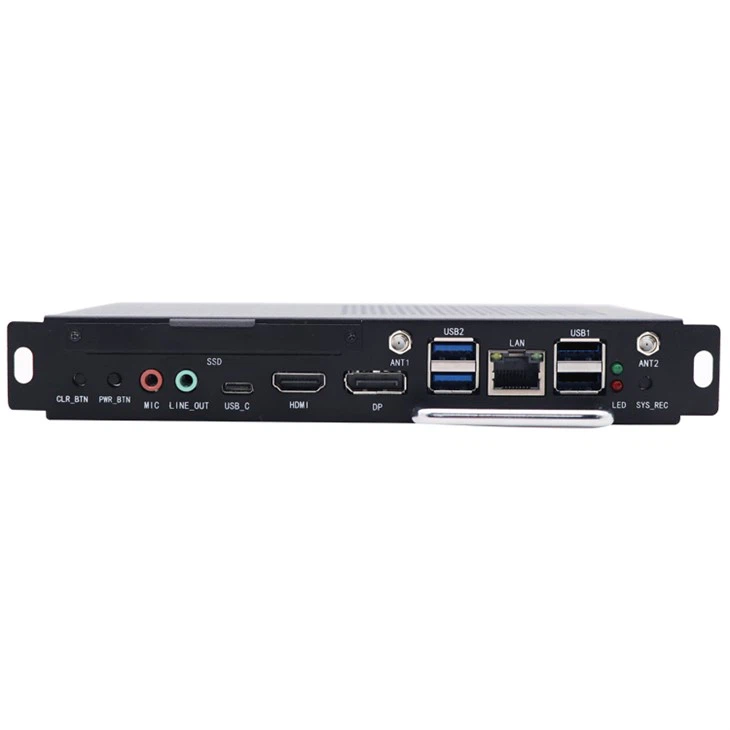
The OPS I5 is built with a foundation of advanced technology. It is equipped with an Intel Core i5 processor, which is renowned for its multi - core processing capabilities. The multi - core architecture allows the OPS I5 to execute multiple instructions simultaneously, significantly enhancing its processing power. This is crucial for database operations, as databases often involve complex queries that require parallel processing to achieve optimal performance.
In addition to the powerful processor, the OPS I5 comes with a generous amount of RAM. The sufficient RAM enables the system to store and quickly access frequently used data and program instructions. When dealing with heavy database operations, having enough RAM can prevent the system from constantly swapping data between the memory and the hard drive, which can be a major bottleneck in performance.
Moreover, the OPS I5 supports high - speed storage interfaces. This means that it can be paired with fast solid - state drives (SSDs) or other high - performance storage solutions. The high - speed storage is essential for reducing the time it takes to read and write data, which is a critical factor in database operations. For example, when running large - scale data retrieval or update operations, a fast storage device can significantly improve the overall response time.
Performance Metrics
To better understand the OPS I5's ability to handle heavy database operations, we need to look at some performance metrics. Two important metrics in this context are Input/Output Operations Per Second (IOPS).
The 1036 - IOPS and 1744 - IOPS are relevant points of reference. These IOPS values represent the number of read and write operations that the system can perform in one second. A higher IOPS value generally indicates better performance in handling data input and output, which is crucial for database operations.
In database systems, transactions such as data inserts, updates, and deletes involve a large number of input and output operations. A system with a high IOPS can process these transactions more quickly, reducing the overall transaction time. For example, in a real - time analytics database where data is constantly being updated and queried, a high IOPS can ensure that the system can keep up with the high - volume data flow.
The OPS I5, when configured with appropriate storage and other components, can achieve relatively high IOPS values. This means that it has the potential to handle a large number of database transactions per second, making it suitable for many heavy - duty database scenarios.
Real - World Use Cases
Let's take a look at some real - world scenarios to see how the OPS I5 performs in heavy database operations.
Small to Medium - Sized Enterprises (SMEs)
In SMEs, databases are often used to manage customer information, inventory, and financial data. These databases may not have the same scale as those in large enterprises, but they still require reliable and efficient performance.
The OPS I5 can be an excellent choice for SMEs. Its cost - effectiveness makes it an attractive option for companies with limited budgets. At the same time, its performance is sufficient to handle the daily database operations of SMEs. For example, a small retail business may use a database to manage its inventory. The OPS I5 can handle tasks such as inventory updates, order processing, and sales reporting efficiently, ensuring that the business runs smoothly.
Web - Based Applications
Many web - based applications rely on databases to store user information, content, and other data. These applications often face high traffic and require quick response times.
The OPS I5 can be integrated into web servers to support the database operations of these applications. For instance, a content - management system (CMS) may use a database to store articles, images, and user comments. The OPS I5 can handle the read and write operations of the database, ensuring that the website can load content quickly and handle user interactions smoothly.
Data Analytics
In the field of data analytics, databases are used to store and analyze large amounts of data. The OPS I5 can be used in small - scale data analytics projects. It can handle tasks such as data aggregation, filtering, and statistical analysis. Although it may not be suitable for extremely large - scale big - data analytics projects, it can still provide valuable support for small - to - medium - sized data analytics tasks.

Limitations and Considerations
While the OPS I5 has many advantages in handling heavy database operations, it also has some limitations.
Scalability
For very large - scale enterprise databases that require continuous growth and expansion, the OPS I5 may have limitations in terms of scalability. As the database size and the number of users increase, the system may reach its performance ceiling. In such cases, larger - scale server solutions may be required.
Complexity of Database Operations
Some highly complex database operations, such as those involving advanced data mining algorithms or complex multi - dimensional queries, may pose challenges for the OPS I5. These operations often require more powerful processing capabilities and specialized hardware.
However, for a wide range of common heavy database operations, with proper configuration and optimization, the OPS I5 can still provide satisfactory performance.
Conclusion
In conclusion, the OPS I5 has the potential to handle heavy database operations in many scenarios. Its technical specifications, performance metrics, and real - world use cases all indicate that it can be a reliable choice for small - to - medium - sized database applications.
If you are considering a solution for your database operations and are interested in learning more about how the OPS I5 can meet your needs, I encourage you to reach out for a detailed discussion. Whether you are a small business owner, a web developer, or a data analyst, we can work together to find the best configuration of the OPS I5 for your specific requirements. Contact us to start the procurement negotiation process and explore how the OPS I5 can enhance your database performance.
References
- Intel documentation on Core i5 processors
- Industry reports on database performance metrics
- Case studies on the use of OPS I5 in various applications